
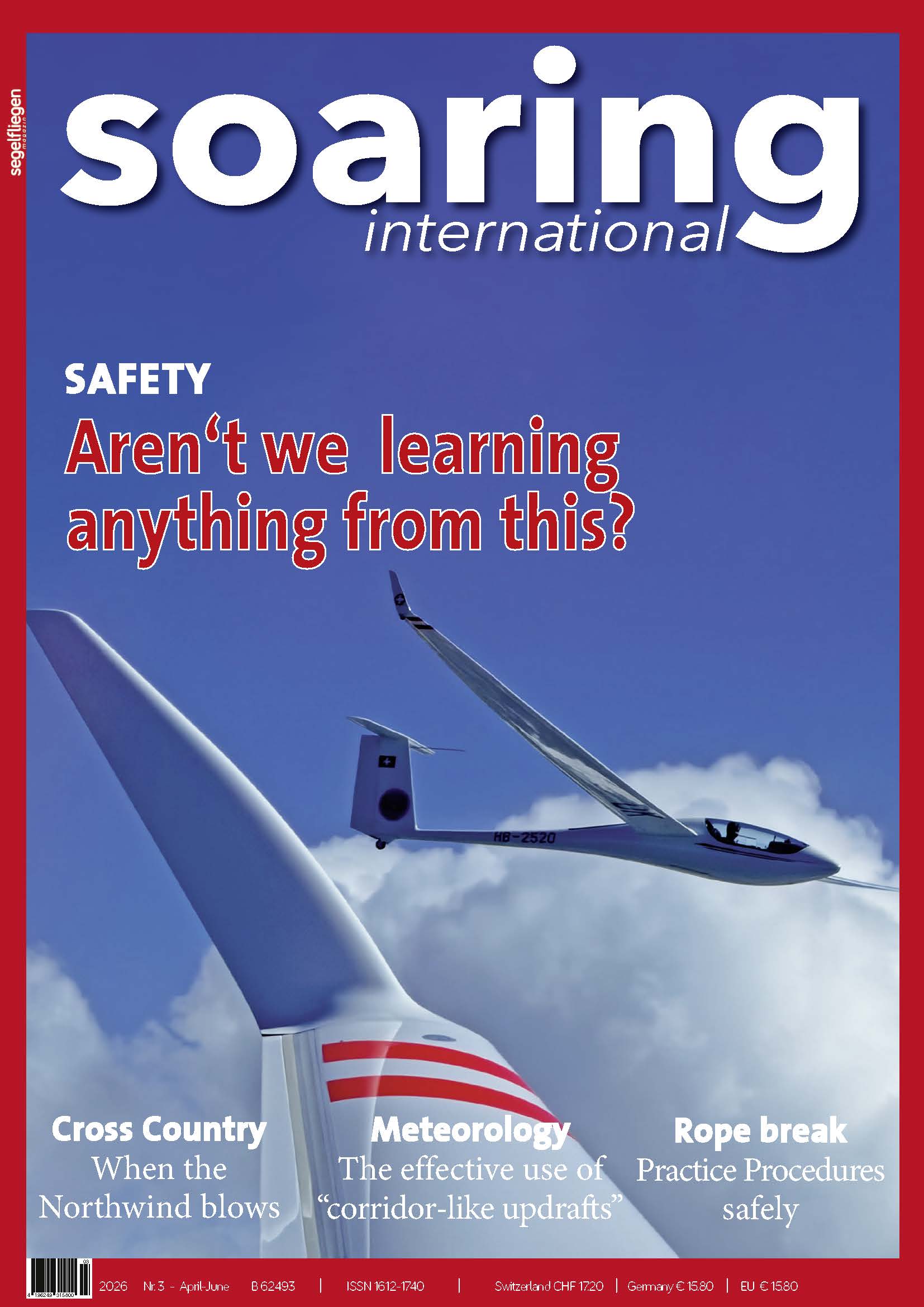
Aren’t we learning anything from this? Why are we starting with a serious topic? Because the causes of accidents have remained the same for years, because safety in gliding is paramount, and because there are definitely solutions that can help prevent accidents – accidents like crash during the landing approach or the one that occurred at the 13th FAI Gliding Grand Prix in Varese. Safety first – that hasn’t changed, and it also applies to practice safely, interruption during a winch launch. But then it’s all about the joy of flying: What flight paths are there when the nortz wind blows, what can we learn from the masters, since world-class pilots do so much right, how do you discover lots of news from the East while hunting for badges, how does it feel when a year takes flight and how important is it to remain flexible when faced with weather-stress? In any case, it’s helpful to make effective use of main lines and to be there in the cockpit when it counts. The story of Jaroslac Potmesil and HPH shows that you can turn gliding in a 12 hours of hobbies every day and a successful career. And the Kranich III – which doesn’t want to sit in a museum but to fly – proves that this hobby never gets old. Commitment is always needed – one example is the team that got the platform segelflug.de up and running again; another example is those who, in the spirit of good airmanship, lent a helping hand – or rather, a helping wing – to our “air wanderer.”
And now: enjoy reading! Click here for the latest issue
Curious about what’s inside? Then take a look here:
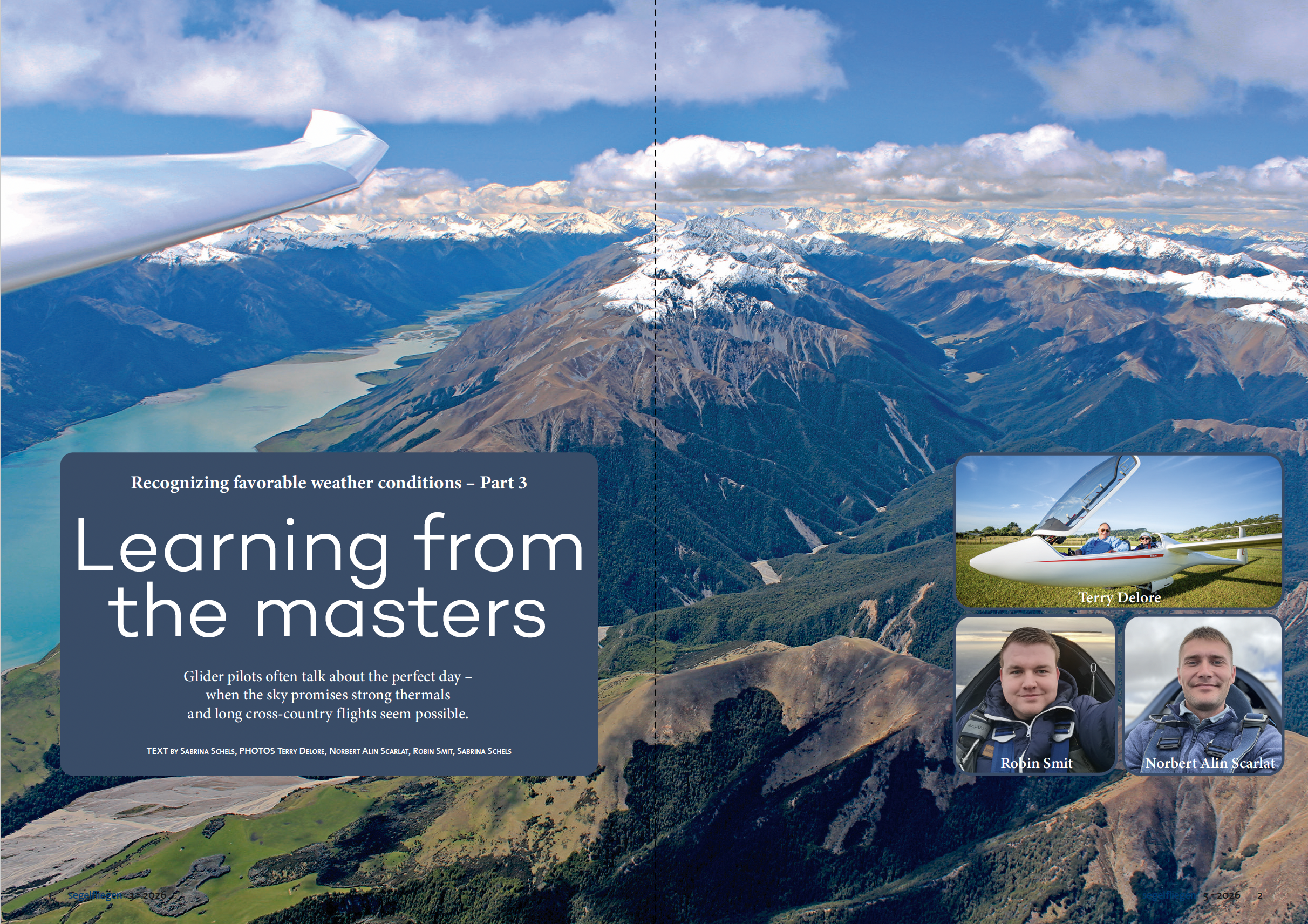
Soaring pilots often talk about the perfect day—when the sky offers strong lift and the promise of long distances. Throughout this series we have explored the factors which contribute to great soaring flights—from understanding the weather to the requirements for making good decisions in the air. Yet much of this knowledge comes from practical experience: hours spent observing the sky, the decisions we made in flight, and learning from both successes and mistakes. But what exactly makes a day special? And what do highly accomplished pilots do differently to turn promising weather into truly exceptional flights?
To explore this further, I spoke with three world-class pilots from different parts of the world. Each has developed their own strategies and perspectives on planning and flying great cross-country flights.
In this final part of the series, they share their stories about their most memorable flights, and the lessons they have learned over thousands of hours in the air—offering valuable insights into how world-class pilots recognize opportunities, manage uncertainty, and make the most of what the sky has to offer.
Firstly, meet Terry Delore, with over 14,000 hours in gliders. He has flown not only in his home country of New Zealand but also in Australia, the US, UK, France, Austria, Italy, Argentina, Chile, South Africa, and Namibia. For him, a great day is using “the extremities of the day, from the first to the last thermal,” tackling the most difficult situations, or flying with friends to explore new areas together.
His most memorable flight was flying the length of New Zealand—from Bluff to Cape Reinga. The preparation alone took about 20 years, and he had to use everything he knew. “Looking back, the difficulty factor was up with everything,” he said. He chose this flight because not everyone could do it and because it had the “best impact for promoting the sport to the general public. It captured people’s imagination on what soaring is about.”
Norbert Alin Scarlat started gliding at age 15 in Romania and has since logged over 4,400 hours across Europe and New Zealand. After extensive competition flying, he now prefers long-distance flights. A great soaring day for him is one that combines all types of lift—thermals, wave, convergence, and ridge. “I find those days interesting and sometimes challenging because I need to adapt from high altitude flying to low altitude and back.”
An attempt in a 2000 km pre-declared 3TP task from Omarama with Justin Wills in a Duo Discus in 2023 became Norbert’s most memorable flight. It was, in his words, “one of the most difficult wave days I’ve ever flown in New Zealand—blue wave and extreme heat, even at high altitude.” They turned back 80 km short of the last turnpoint when the day weakened. “In the end it was the right decision, otherwise it would have been a very long retrieve.”
And lastly, Robin Smit, a Dutch junior pilot with nearly 3,000 hours. He has flown in the Netherlands, Belgium, Germany, France, Czech Republic, Hungary, the United Kingdom, Lithuania, Australia, and New Zealand. “My favourite place to fly is by far New Zealand. I was lucky enough to spend one season there, and I never learnt so much in such a short time.” For Robin, a perfect soaring day is one you can see coming days in advance—arriving early at the airfield, working through weak morning thermals, cruising at full speed during the best part of the day, and adjusting to match the weaker evening conditions while enjoying the views and finishing with a beer among friends.
His most memorable flight was his first day win at the Junior World Gliding Championships in Narromine, Australia. For the 600 km triangle they had “brilliant weather with nice Cu’s, high bases and strong thermals.” He and his teammate finished in under four hours at an average speed of 158 km/h. “When I landed, my first thought was: THIS IS NOT POSSIBLE!”
What strategies and tools do those soaring aces use to recognize and plan a good soaring day?
Read the article in the current issue
