
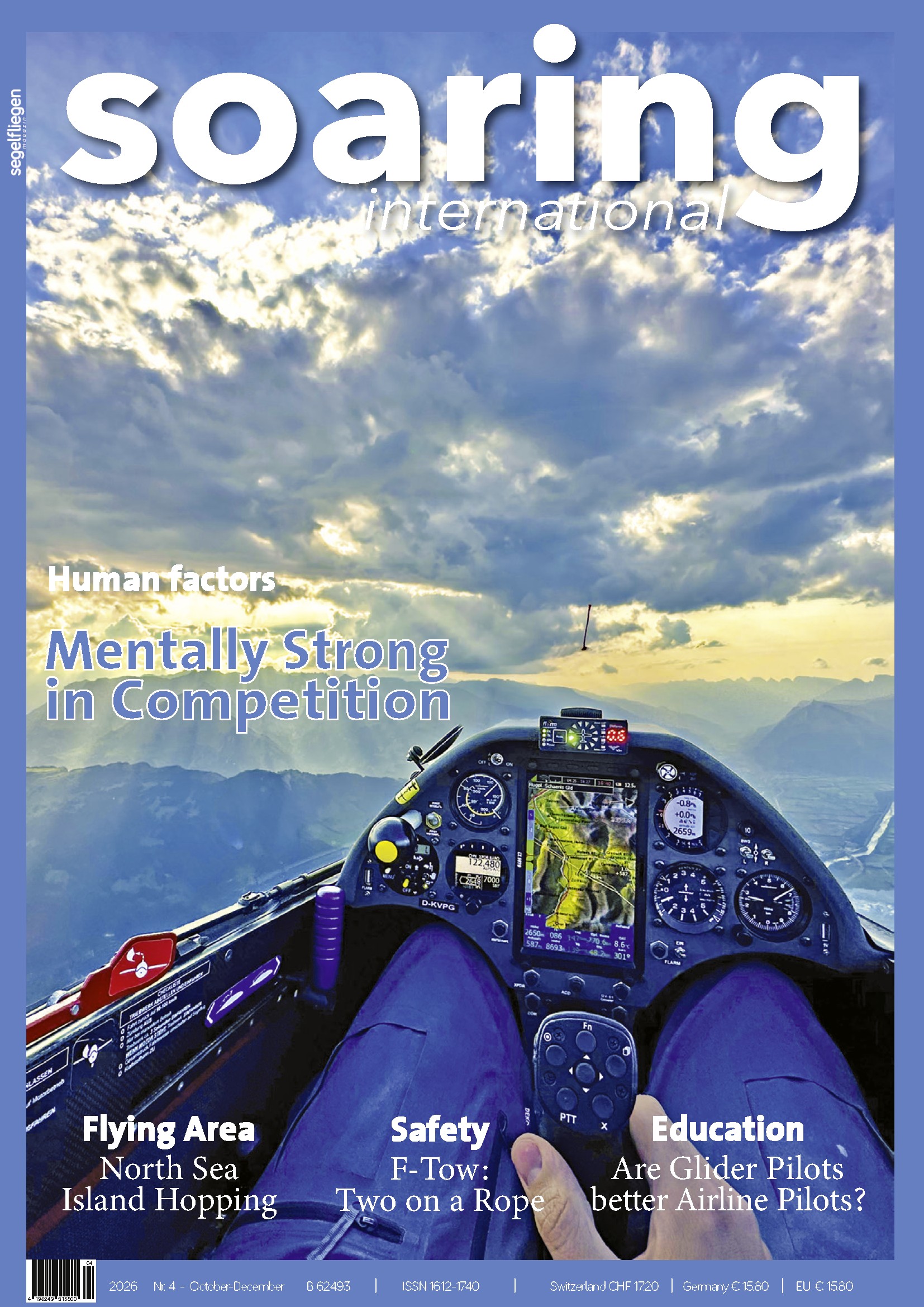
As (almost) always, we begin our latest issue with “safety first” – Safety in Gliding – and take a look at the statistics: Have technological advances and modern training made a difference? The second article attempts to answer the question: Are glider pilots better airline pilots? In addition to flying expertise, teamwork is essential in the airliner cockpit – and it’s just as crucial in gliding, for example when we’re hanging from the tow rope as a pair and the tow pilot and glider pilot must rely on one another. You also have to watch out for others during the traffic pattern, which is more than just a rectangle because that’s where all flight operations converge. Anyone who has to make a detour to the cows instead of landing at the airfield is grateful when the wing strut sacrifices itself and a predetermined breaking point prevents structural damage. And since we can’t do without it, let’s take a closer look at the inner workings of the thermal before we simply enjoy the glide; we glide into the Spanish summer wave, explore the Frisian Islands between thermals, the Wadden Sea, and the temptation of Heligoland, accompany our cross-country glider – true to the motto: Just don’t give up – through the drizzle to Samedan, and take a short but thrilling flight – take off, fly, honk, land – with the T.21 Slingsby over South Africa. Your want to know How much water ballast should you use on any given day? We show you how to optimize water ballast in 5 steps. And when flying a glider cross-country stronger lift means faster speeds in many cases, the overall impact on average speed ist less than many pilots assume. This is evident in hidden cost of chasing better lift. For those who prefer a bit of adrenaline but still want to be mentally strong in competition, our coach has the right tips. There was also plenty of adrenaline at the aerobatics days in Kamen – no competition, but plenty of training, a variety of aircraft types, and history. Jonker Sailplanes boasts a success story with a long history, as does gliding at Hesselberg, Nuremberg’s very own Wasserkuppe. And then sit back, relax, and follow our columnist, who’s certain: you need a little luck, too!
And now: enjoy reading! Click here for the latest issue
Curious about what’s inside? Then take a look here:
Most of the great stories of gliding take place in the Alps. That’s where records are set, championships are won, and the images we recognize from calendars and movies are captured: mighty trails of clouds along snow-covered ridges, endless glides over rock and ice.
The North is Calling
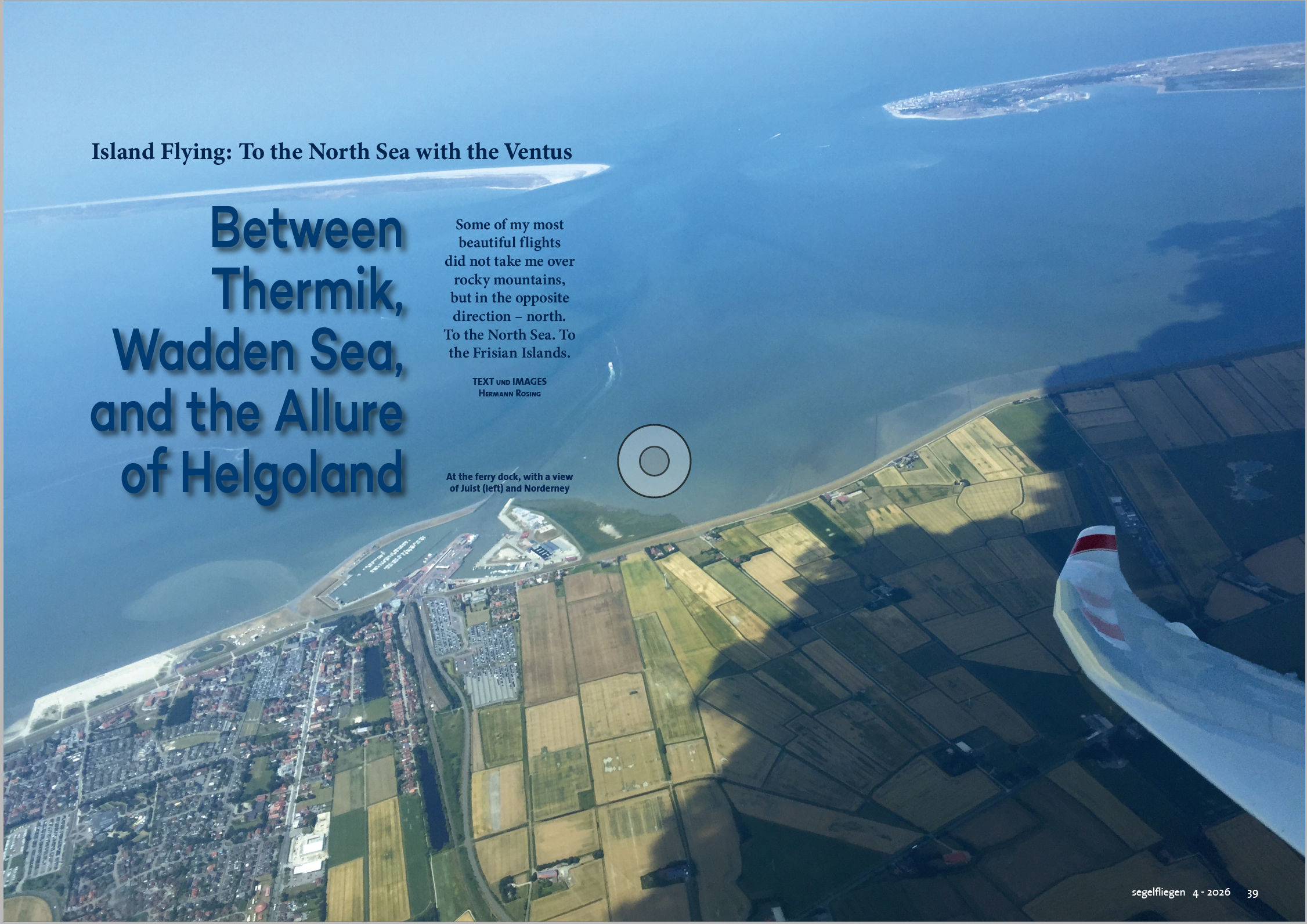
It’s a whole different story heading toward the North Sea and the Frisian Islands. There, a different kind of gliding awaits. No spectacular mountain ranges, no high speeds along massive slopes. Instead, a flying area that slowly lures the glider pilot out of their comfort zone. The base drops, the thermals weaken, and the wind picks up. Strictly speaking, you’re flying to places you wouldn’t normally want to go as a glider pilot. And that’s exactly what makes it so appealing.
An idea just won‘t let go
The idea for this flight came about during a conversation with Tim Markwald, the owner of M+D Flugzeugbau. At some point, Tim mentioned, almost in passing, that he had been offering a special prize (two kegs of beer) for years:
Starting from the Bollenberger Feld airfield, the pilot was to fly around two Frisian islands as waypoints. A flight that sounded simple – and was difficult precisely because of that.
Once it was clear that I was also allowed to fly the route from Borken-Hoxfeld, I couldn’t stop thinking about it. Again and again, I checked weather charts, compared forecasts, and considered what conditions would truly be necessary to execute such a flight successfully. After all, the North Sea doesn’t forgive poor planning.
Among Buzzards and Seagulls
The closer you get to the coast, the more noticeably the atmosphere changes. The thermals become less reliable and the wind stronger. The landscape, too, tells you that you’re moving away from familiar gliding terrain. The buzzards become fewer and fewer. Instead, more and more seagulls appear. And when those seagulls eventually start walking on land, that’s when – at the very latest – you should turn back.
A Day of Unusual Weather
On July 17, 2018, everything finally fell into place. Even the weather forecast was unusual. Particularly striking was the base height of around 6,500‘ predicted for the North Sea. That was exceptionally good for the coastal area. At the same time, however, excessive cloud development was forecast, and the westerly wind was expected to pick up significantly as the day progressed. A typical day, then, when one had to ask oneself: “Is this really going to work – or will it just be a nice try?”
Start in Borken-Hox
At 12:00 p.m., I took off in my Ventus 2 CM “D-KAYY” from Borken-Hoxfeld. Shortly after takeoff, the day was already shaping up better than expected. The base quickly rose to about 5,000‘, the climb rates were solid, and the flight to the northwest progressed surprisingly quickly. With every kilometer, it became clearer that the forecast might actually be right.
By the time I reached Lingen, at the latest, the day had begun to feel extraordinary. The base continued to rise and eventually reached nearly 6,500‘. For a North Sea flight, it felt almost surreal. The kilometers toward the coast disappeared astonishingly quickly beneath the wings. At 2:15 p.m., I flew over Norderney as my first waypoint – at an altitude of nearly 6,500‘. I had never flown to the North Sea that fast before.
About the Wadden Sea
Anyone who has flown to the islands several times usually knows the routine. You approach the coast cautiously, feel your way out toward the islands, fly back to the mainland to regain altitude, and then try to reach the next island. Especially when there are several waypoints, this often means constantly shuttling back and forth between the island and the mainland.
What happens next? You can read about it in our latest issue.
