
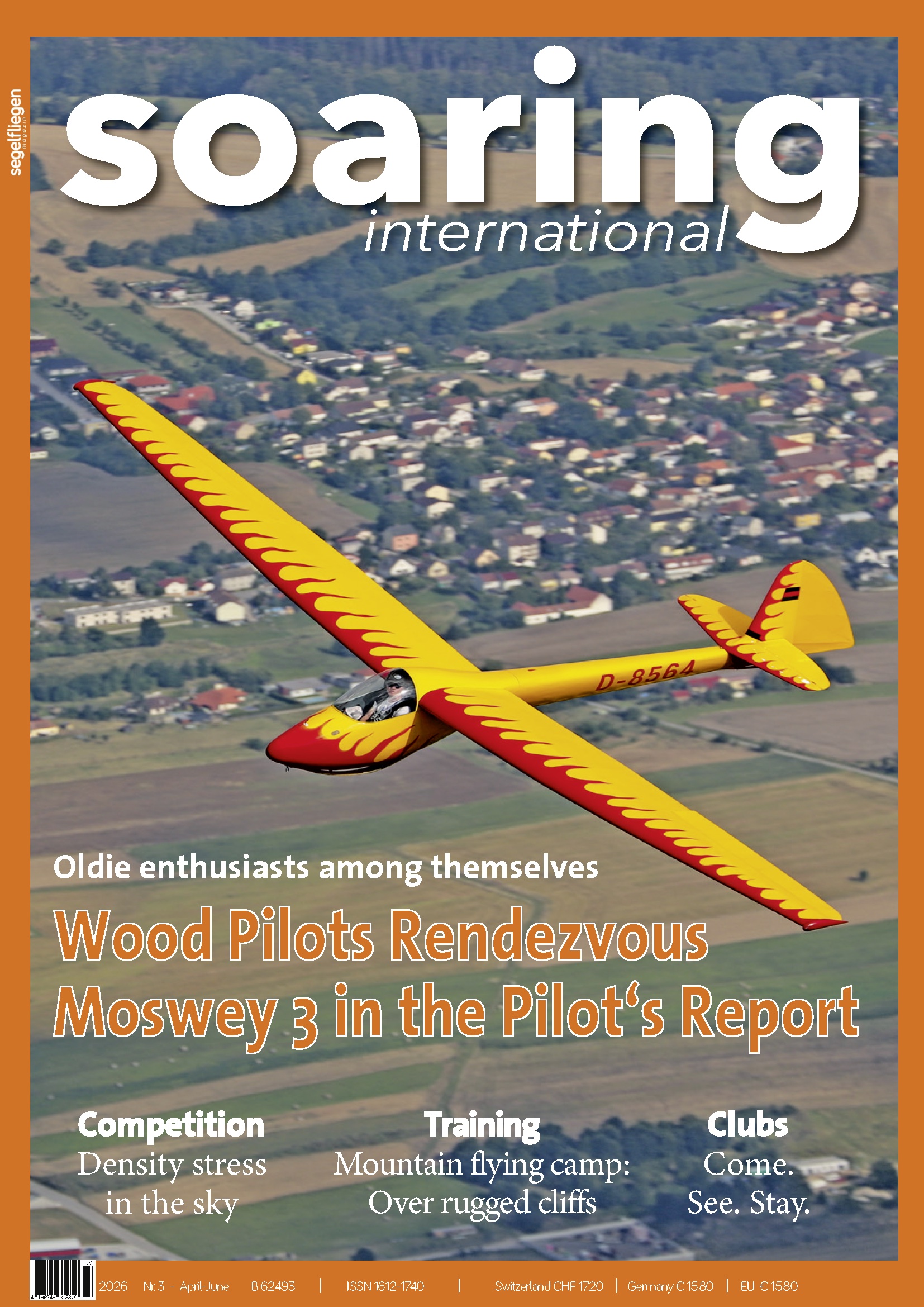
Density stress in the Sky – that’s the focus of our cover story in this issue. Sebastian Kawa, Wolfgang Janowitsch, Bert Schmelzer, and Aude Untersee discuss ways to make competitions safer with our editor-in-chief. One positive example is the Gliding Grand Prix, which we will be covering regularly as a media partner. But even outside of competitions, safety in gliding must always come first – to that end, we take you to a mountain gliding camp, learn from a rope break accident, and discover how to avoid it by understanding the risks of aborted takeoffs during winch launches. Then, however, you can enjoy beautiful flights just like our authors, who show you how to make the right decisions in good weather conditions, taking you on a daring flight from Prievidza to Radevormwald, a dream flight from Samaden to Serres, and an exciting cross-country gliding trip through Central Europe – complete with hot tips to ensure everything goes smoothly. But the fact that even weather experts can sometimes be wrong – and that everything turns out fine in the end – is demonstrated by the meteorological roller coaster ride of August 9, 2025. In contrast, our oldie pilots have it easy, whether in the Pilot’s Report on the Moswey 3 or at the VGC Rally in Hosin. Than the dedicated team at the Landsberg-based Geratshof Gliding Club shows how to get young people excited about gliding, and we also take a look beyond our borders at the U.S. Air Force Soaring Academy. No flight is complete without the right equipment: our author tested the Airdata Indicator ADI2, and we take a look at the development of the HAWK. Enjoy reading: click here for the latest issue!
Curious about the content? Then take a look here:
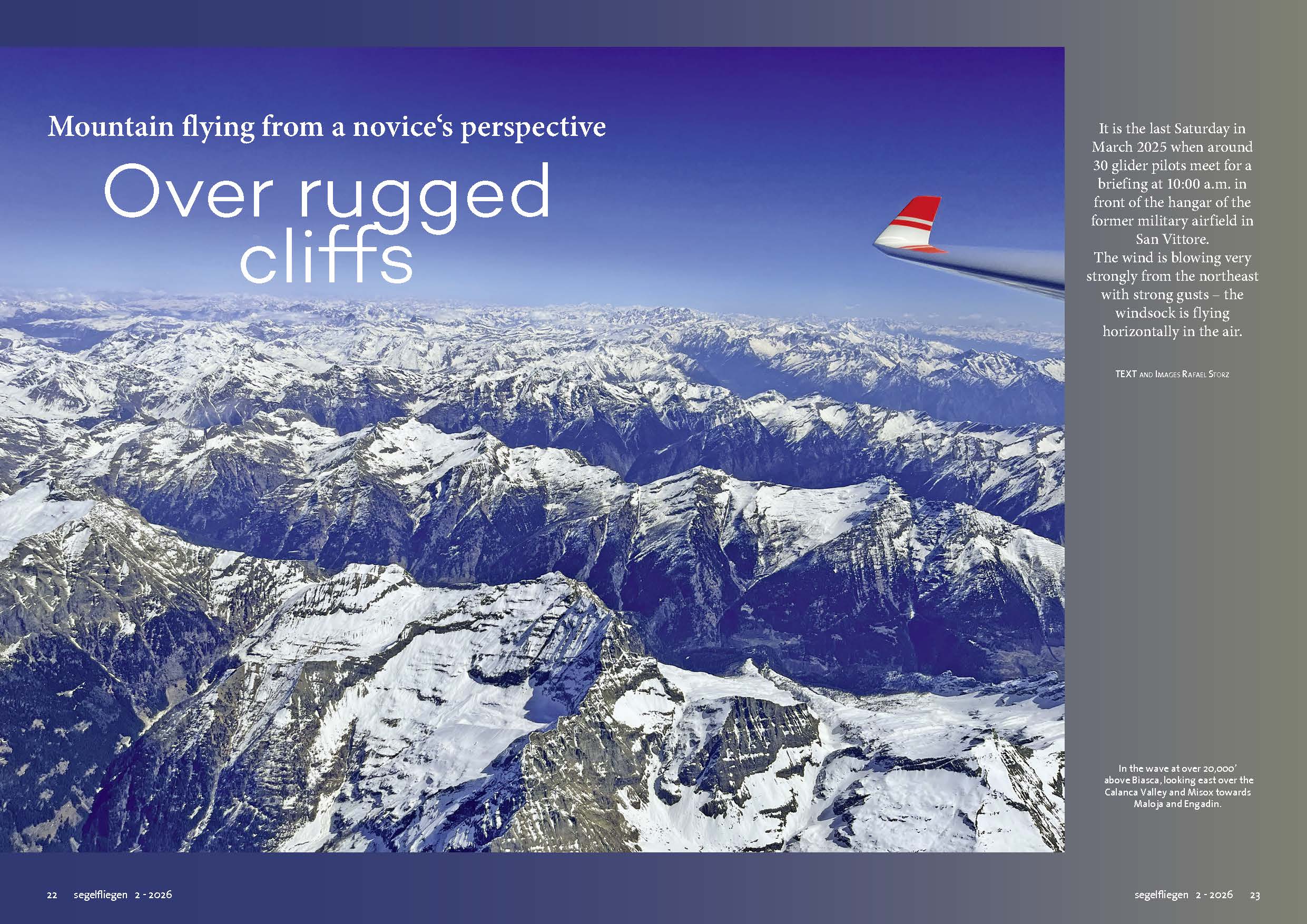
Day 1 in San Vittore, ICAO code LSXV. There is a foehn wind with a high north of the Alps and a pressure difference of around 0.3” of mercury between St. Gallen and Locarno. For most pilots, these are not ideal conditions for a first day of flying. This leaves plenty of time to familiarize themselves with the special features of the mountain airfield in San Vittore, which is used as Heli Rezia‘s operational base all year round.
The airfield with runway 08/26 is made up of perforated metal sheets, which are more or less overgrown with grass. Although they were laid a good 50 years ago, the perforated sheets still have a stabilizing effect and form a level runway. To the north is a grass runway. Thanks to the unprecedented efforts of a few gliding enthusiasts, the former military airfield was returned to aviation after more than four decades of disuse. In cooperation with the FOCA (Federal Office of Civil Aviation in Switzerland), it has been possible to use this site for a total of 21 days per year in March and April for gliding as part of a gliding camp. This has now been done very successfully for several years.
Geographical location and organization
The San Vittore airfield is located at the southernmost tip of Graubünden, coming from the Bernadino Pass at the end of the Misox valley, at an altitude of 870’ above sea level in a mountain valley that is less than 3,300’ wide in places, with steep peaks rising to around 6,600’ directly above it. The Locarno TMAs are in the immediate vicinity south of the airfield. Further south, you are in Italian airspace. And west of the airfield is AWY A9.2 from FL130. Overall, the requirements for pilots are high, not only for a mountain flight novice like the author. But more on that in a moment.
The gliding camp in San Vittore is organized by the board of the “Gruppo di Volo a Vela San Vittore” association. The flight dispatchers are provided by the 10 participating flying groups and change daily. The weather briefing takes place every morning at 10:00 a.m., NOTAM and DABS are announced, and the market wagon is restocked daily so that pilots can easily get fresh sandwiches, pastries, and drinks at the airfield. The organization of the flying camp is excellent. It shows the experience that has been gained in recent years.
Up to 40 pilots gather at the site at any one time during the camp. The atmosphere is typically camp-like, with a great sense of camaraderie. The participants from the many gliding groups from Switzerland and one group from Bavaria support and help each other. The daily routine on flying days is always the same: after the briefing at the latest, the aircraft are pulled out of the hangars, assembled, and then lined up in a row on the runway. As soon as the first pilots are able to keep their machines in the air, things happen in quick succession. With up to four tow planes, everyone is towed up in a short time. Depending on the weather, the release points are Claro, Laura, Matro, or St. Maria, which are communicated to the tow pilot by the launch assistant passing the written flight registration through the capo window. Within two hours, the entire field is usually in the air.
You can read the full report in our current issue, 02-2026
